Joshua Tree National Park
There is little to no cell service in Joshua Tree National Park.
If you download the guide and save it, you’ll be able to use it offline in the park.
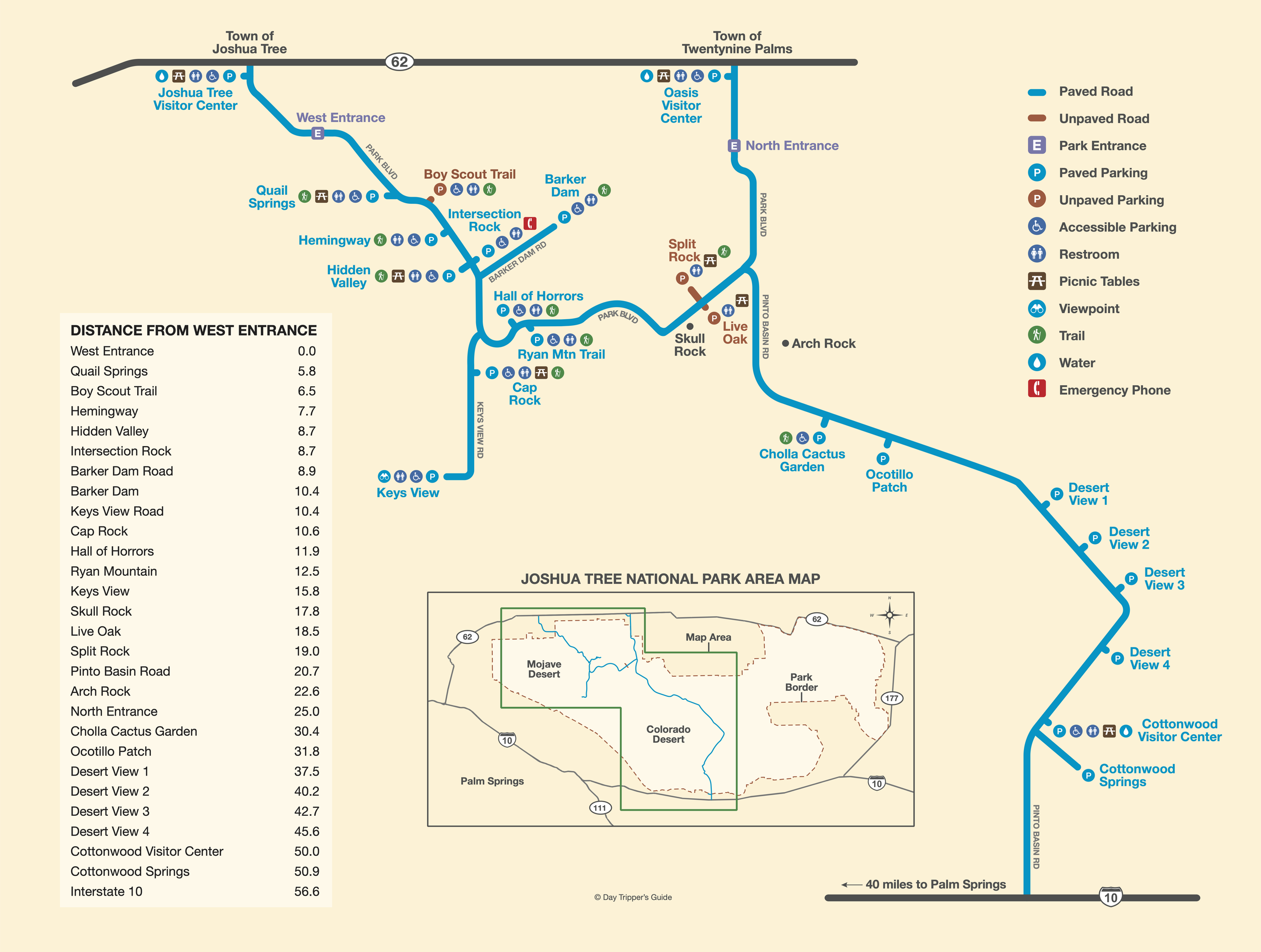
West Entrance
For most visitors, the quickest way into the park is through the West Entrance. As a result, the line to get in can get long and extremely time-consuming, especially mid-morning and on weekends. To avoid waiting in line, the best thing you can do is arrive early in the morning. How early? If you’re in the park for sunrise, or shortly thereafter, you’ll not only avoid waiting in line, you’ll have the entire park all to yourself for the first few hours of the day.
Facilities
At the park entrance, there’s a small paved parking area with drinking water and a real restroom. Inside the park, there is no drinking water and all the restrooms are basic, waterless vault toilets.
Expect little to no cell service beyond this point. Be sure to download the guide before you enter.
Quail Springs
This is the first large parking area after the West Entrance, so it can get crowded here. If it’s too crowded or you don’t feel like stopping so soon after entering the park, there are other areas with restrooms, picnic tables, and much better trails ahead.
Facilities
Large paved parking area with a restroom and picnic tables.
Area Description
As you make the turn into Quail Springs, you’ll see a small parking area in front of a large rock formation. If you follow the road around the formation, it leads to a much larger parking area with a restroom and several picnic tables. If you want to stretch your legs, there’s an easy path around the formation. If you go counterclockwise, you’ll have a slight downhill walk with better views.
Boy Scout to Willow Hole Trail
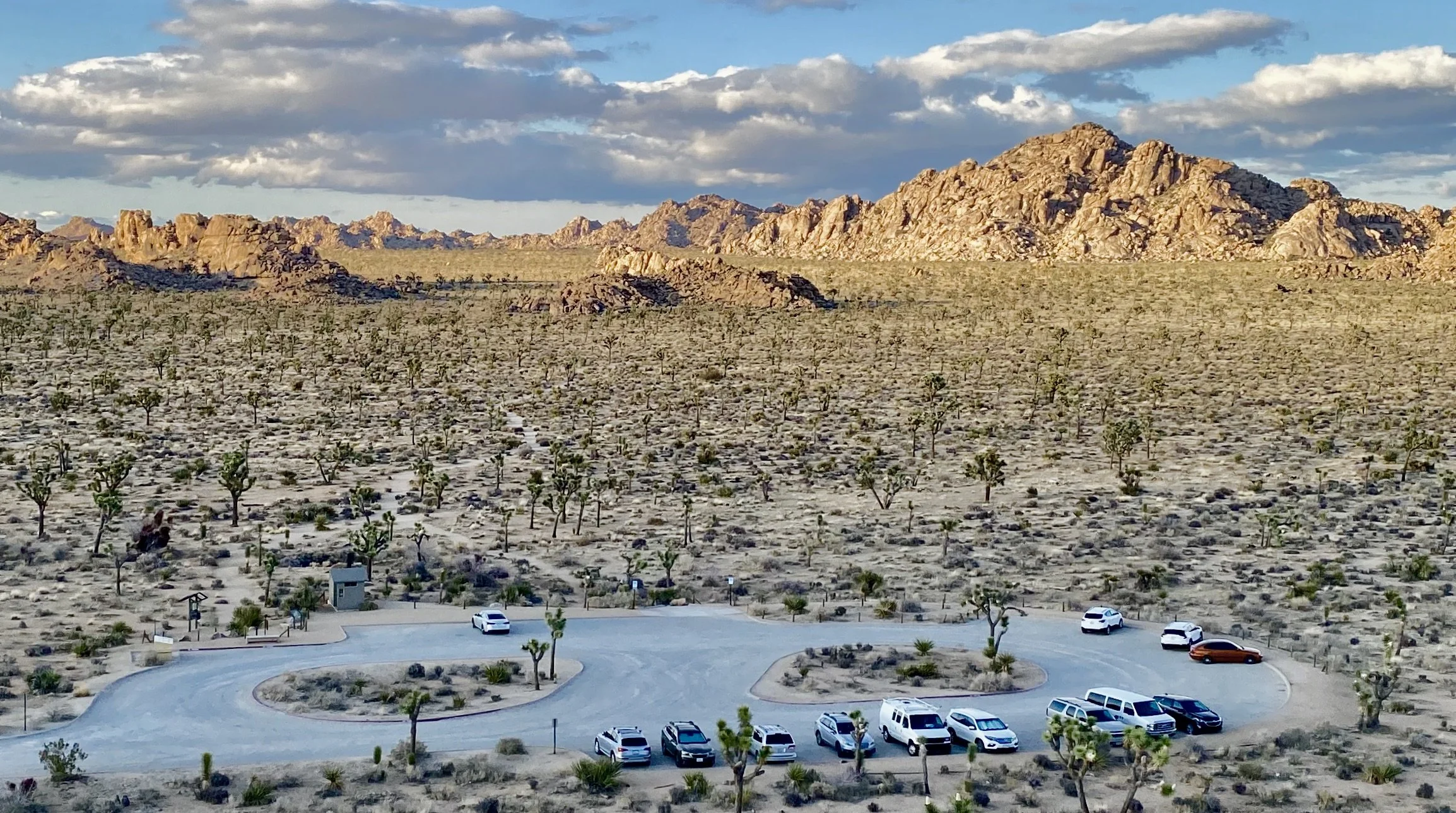
This is one of my favorite walks in the park. The first mile makes for an easy out-and-back stroll through a beautiful area, while the longer trail makes for a really nice hike. The trail is great anytime of day, but this one catches the last bit of sun, making it an excellent hike about an hour or two before sunset.
Facilities
Large unpaved parking area with a restroom.
Trail Description
At the start, the trail crosses a sandy wash, then becomes wide and hard-packed with a gentle rise for the first mile. In half a mile, you’ll come to a boulder pile with a few rocks to sit and rest on. At one mile, you’ll reach the huge mountain of granite you can see from the parking area—a good turnaround point if you’re looking for a shorter walk.
From there, the trail turns left and continues to climb as it follows the base of the mountain. In a third of a mile, you’ll reach a fork marked by a park sign for the Willow Hole Trail. If you follow this trail to the right a tenth of a mile, you’ll come to a natural high point where the trail dips and you suddenly get this amazing view over a big, beautiful valley.
The trail continues into the heart of the valley, then turns a little to the right and heads up it. Near the top of the valley, roughly 2.3 miles from the trailhead, you’ll see a towering rock formation on the right with a spine of granite that comes right to the edge of the trail. If you climb up on this spine, you’ll get an excellent 360-degree view over one of the prettiest areas of the park. Watching the sunset from up there can be pretty epic.
This is also a good place to turn around. Beyond this point, the character of the trail changes dramatically. The final mile follows a sandy wash through a canyon of large rock formations to a park sign marking the trail’s end. From there, it’s about 3.5 miles back to the trailhead.
Hemingway
Most people drive right by Hemingway, but it’s definitely worth a quick stop. The area is surrounded by huge granite rock formations, and there’s a great little trail to walk. If I had my mom or young kids with me, I’d most certainly bring them here.
Facilities
Medium-sized paved parking area with a restroom.
Trail Description
At the far right side of the parking area, you’ll see a rock-lined trail that leads to a healthy pinyon pine standing guard over an impressive little rock formation. From here, the trail crosses a beautiful little valley to the Hemingway Buttress—a large wall of granite with several classic rock climbs. If you make your way to the buttress, keep an eye out for the view looking north over the desert with the mountains way off in the distance.
Hidden Valley
This is one of the largest and busiest areas in the park. The big draw here is the extremely popular Hidden Valley Nature Trail—a mile-long loop through a beautiful valley surrounded by massive rock formations. The trail can get very hot and crowded in the afternoon, so it’s best to walk this one in the morning. You’ll also find quite a few picnic tables at Hidden Valley, which makes it a popular place to stop and have lunch.
If you get to Hidden Valley and it’s just too crowded to stop, consider heading across the street to Intersection Rock or driving up the road to the Cap Rock Accessible Nature Trail and Picnic Area. Both attract fewer people and offer a quieter, more relaxed way to experience this beautiful area of the park.
Facilities
Large paved parking area with a paved walkway along both sides of the road, several restrooms, and lots of picnic tables.
Area Description
As you enter the one-way loop road through Hidden Valley, you’ll see the trailhead for the nature trail on the right. Just beyond that, you’ll come to a short loop road off the main road with limited parking and a few picnic tables tucked against a large wall of boulders.
Just beyond that is the least crowded and most accessible area in Hidden Valley. Along here, you’ll find quite a few picnic tables right next to the parking area and several more tucked up near the base of Turtle Rock—a huge rock formation that, from a distance, resembles a giant turtle. The area around Turtle Rock is also fun and easy to explore.
Trail Description
The Nature Trail has quite a few rock steps, uneven natural surfaces, patches of soft sand, a slight downhill grade for the first half mile, and a slight uphill grade for the second half mile. Because the trail loops through a valley of huge rock formations, it can get very hot. Again, to avoid the heat and the crowds, it’s best to walk this trail early in the morning. A nice alternative to the nature trail is a walk around Turtle Rock. It’s not very long, and the path is well worn and easy to follow.
Intersection Rock
For me, this area is the heart and soul of the park. If I had to recommend one place to get a sense of what makes Joshua Tree so special to so many people, this would be it. Some of the best exploring in the park can be found in the backcountry around here. It’s also an excellent place to get a feel for Joshua Tree’s rock climbing culture. Don’t be surprised to see people climbing the granite formations all around here. It’s home to some of the park’s most popular and legendary routes.
Facilities
Large paved parking area with a restroom and an emergency phone next to the restroom.
Area Description
As you enter the parking area, the huge dome of granite on the right is called Intersection Rock, and the one on the left is called The Old Woman (see photo below). Across the way is the Hidden Valley Campground—a home away from home for climbers from around the world.
For a bird’s-eye view of the action, head to the open area between the parking lot and the campground. There you’ll find a huge slab of granite, almost like a natural amphitheater. If you walk up on it, which is easy in places, you’ll get a fantastic view of the entire area. If you have binoculars, this is a good place to use them.
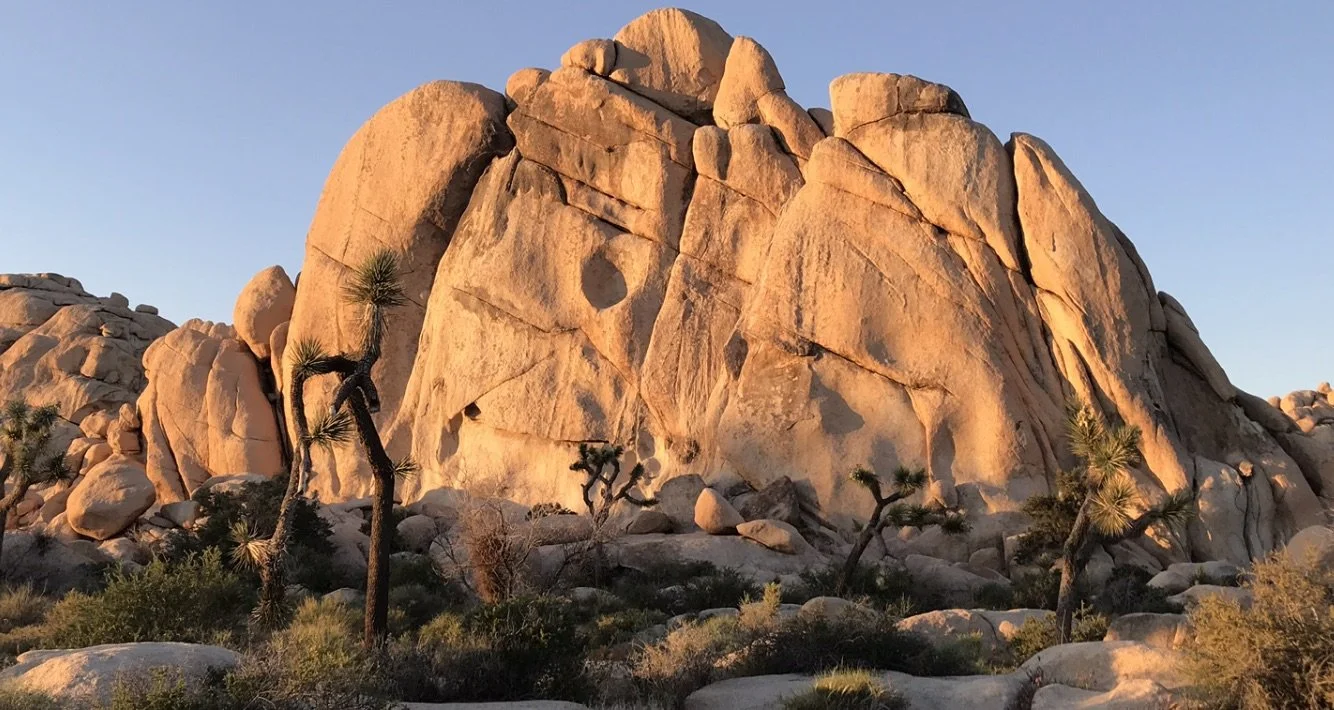
Over the years, I’ve spent quite a bit of time exploring the backcountry around here—wandering through the beautiful valleys, scrambling up the massive rock formations, immersing myself in this incredible desert landscape. I came to Joshua Tree for the climbing, but it was the wandering that made me fall in love with this place.
Barker Dam
This is one of my favorite areas in the park to explore. The extremely popular Barker Dam Trail loops out a little over a mile to an old dam built by cowboys in the late 1800s, then cuts through the heart of one of the most beautiful valleys in the park, with endless opportunities for walking, exploring, and scrambling. If you’re a climber, the valley is home to some of the park’s most iconic bouldering problems, including a world-class traverse called Gunsmoke.
Facilities
Large paved parking area with a restroom.
Trail Description
The trail leads a few hundred yards into a canyon, then continues through the canyon for about a third of a mile to the area above the old dam. For much of the year, the basin above the dam is dry, but after a heavy rainfall or during the winter and spring months, it can transform into a beautiful little lake.
If the basin is holding water, watching the sunrise from here can be magical. Early mornings can feel especially peaceful, and the lake often attracts a variety of birds and other wildlife.
The trail continues along the edge of the lake to the top of the dam, then descends a series of rock steps to the valley floor. From there, the trail climbs gently through the heart of the valley, where interpretive signs guide your way and ancient petroglyphs can be found on some of the rock surfaces.
At the top of the valley, the trail cuts through a gentle canyon before returning to the parking area. But don’t be in a rush to get back. I’ve spent entire days wandering around this incredible valley, and I’m always blown away by how much there is to see and do. Plus, if you’re here later in the day, watching the sunset from the head of the valley can be an excellent way to end it.
Keys View Road
This scenic paved road climbs five and a half miles to Keys View—a spectacular viewpoint overlooking Palm Springs and the Coachella Valley. The road is an attraction in its own right as it winds through a beautiful forest of mature Joshua trees on its way to the viewpoint. On the way back down, keep an eye out for the incredible view over the Mojave.
Shortly after turning onto Keys View Road, you’ll come to the Cap Rock Accessible Nature Trail and Picnic Area—one of my favorite areas in the park.
Cap Rock
This is one of those rare places in Joshua Tree where you can experience a really beautiful area of the park on a short, fully accessible nature trail. If I had young kids or someone with limited mobility with me, I’d definitely bring them here.
Facilities
Large paved parking area with a restroom and several picnic tables.
Area Description
As you enter the parking area, you’ll see several picnic tables along the base of Cap Rock—a massive dome of granite with a precarious boulder balanced on top.
In front of the accessible parking, you’ll see a long, rectangular boulder. Just to the right of it is a walkway. If you follow the walkway around the back of the boulder, you’ll find a restroom, another quiet picnic table hiding by the base of Cap Rock, and the start of the accessible loop trail.
Trail Description
At just under half a mile, the accessible loop trail might not be very long, but it sure is pretty. Along the way, you’ll find several park benches with excellent views of the surrounding area—a perfect spot to sit back, relax, and take in the incredible scenery. The combination of rock formations, desert plants, and wide-open views gives the landscape a classic Joshua Tree feel.
The trail is beautiful in both directions, so consider walking it one way, then turning around and walking it back the other way. You’ll be glad you did.
Keys View
A defining experience of Joshua Tree is taking in the amazing view over Palm Springs and the Coachella Valley from Keys View. On a clear day, you can see all the way to the Salton Sea near the Mexican border, as well as two of the tallest mountains in the region—Mt. San Jacinto (10,834 ft) and Mt. San Gorgonio (11,503 ft), the tallest peak in Southern California.
Facilities
Large paved parking area with a paved walkway and restroom.
Area Description
As you approach Keys View, you’ll first come to an ADA viewpoint on the left with two accessible parking spots and a paved walkway leading to a small, protected viewpoint.
As you enter the main parking area for Keys View, you’ll see a small parking area on the right with accessible parking and a restroom. Beyond that, the road becomes one-way as it circles through a larger parking area with more accessible parking and a paved walkway that loops up to the viewpoint.
One way up to the viewpoint is shorter but quite steep. It has a handrail the length of the walkway and a park bench about halfway up. The other way is slightly longer but less steep. It doesn’t have a handrail, but there is a park bench at the viewpoint.
If you’re comfortable with the elevated walkway at the main viewpoint a half-mile up the road, I’d skip the ADA viewpoint. The view from the main viewpoint is much better.
The view is amazing any time of day, but watching the sunrise or sunset from Keys View can be one of the most memorable experiences the park has to offer.
Hall of Horrors
This area of the park has some great rock formations that are really fun to walk around and explore, especially if you’re good at scrambling.
Facilities
Large paved parking area with a restroom.
Area Description
From the parking area, you’ll see a flat, hard-packed trail that loops out to the base of a large rock formation. You’ll also see a number of primitive trails used mostly by climbers to access the large domes of granite scattered throughout the area.
What makes this area unique are the narrow slot canyons hidden inside some of the domes, including one known as the Hall of Horrors. Be careful, though—getting into the slot canyons requires some serious scrambling. If you’re not careful, you can quickly find yourself in over your head.
From the Hall of Horrors, you’ll also get a really nice view of Ryan Mountain to the south—one of the park’s most prominent peaks and home to one of its best hikes. Back in the day, I’d hike to the summit of Ryan Mountain for sunset, then head to the Hall of Horrors after dark. I recorded this one night while wandering around the Hall of Horrors under a full moon…
Ryan Mountain Trail
If you’re looking for an epic hike, this trail to the top of Ryan Mountain should do the trick. From the summit, you can pretty much see the entire park. If hiking to the top sounds a bit much, the views from partway up the trail are great, too.
Facilities
Large paved parking area, restroom.
Trail Description
This 3-mile round-trip trail has lots of rock steps, uneven natural surfaces, and nearly 1,000 feet of steady elevation gain, but the reward is well worth the effort. If you head up for sunrise or sunset, you’ll want a headlamp and maybe a hat, gloves, and a jacket. It can get a little chilly up there, especially if the wind’s howling. If you have binoculars, you’ll want to bring those with you, too.
Beyond Ryan Mountain
After Ryan Mountain, the road climbs through a gentle canyon and out onto an expanse of high desert with a beautiful view over the Mojave and Joshua trees stretching as far as the eye can see. You’ve now entered a quieter, more remote area of the park. Before continuing on, make sure you have enough time. From here, you’ll be heading farther away from the West Entrance, with a longer drive back than you might expect.
Skull Rock
With the help of social media, getting your picture taken next to Skull Rock—a giant boulder that looks like a huge skull—has become one of the most popular attractions in the park.
Personally, I don’t get it. The park is filled with giant boulders that look like faces, animals, you name it. Just use your imagination, and you’ll be amazed at what you see.
Area Description
Parking for Skull Rock is along both sides of the main road, which can turn hectic when it’s busy. If there’s no parking or it’s just too crowded to stop, don’t worry, you’re not missing much. It’s more fun to find your own Skull Rock anyway.
Live Oak Picnic Area
Two little picnic areas here - you want the one on the left.
Facilities
Two small unpaved parking areas with several picnic tables. The parking area on the right has a restroom.
Area Description
Shortly after turning into Live Oak, the unpaved road splits. To the right is a small turnaround parking area with a restroom and a few picnic tables along the base of a large rock formation. To the left is a quieter, more secluded area with a beautiful view over the desert and more picnic tables. If the park is really busy, this is a great place to find a little peace and quiet. It’s also a really fun area to explore.
Split Rock Trail
I love this trail—at least half of it, anyway.
Facilities
From Park Blvd, take the unpaved road half a mile to a large unpaved parking area with a restroom and a few picnic tables.
Trail Description
As you approach the parking area, you’ll see a small parking area with a restroom on your left. Just beyond that is a larger turnaround parking area with several picnic tables near the base of Split Rock—an enormous boulder split in two.
Most people start the 2.5-mile loop to the left of Split Rock, drop into a large valley, and hike it counterclockwise. However, it’s easier and more scenic to begin at the opposite end, just up from the restroom, hike about halfway, then turn around and head back the way you came.
If you go this way, the trail takes you through a few beautiful little valleys with towering rock formations and excellent views of the surrounding area. In about a mile, you’ll reach a park sign for the Face Rock Trail heading off to the left. From here, the Split Rock Trail turns right and winds its way through the desert before climbing to a high point between two large rock formations with a boulder beside the trail. This marks the turnaround point for the out-and-back.
If you want to continue the loop from here, the trail goes over the high point and out onto a high ridge with a view over the desert. From the ridge, you should be able to see Split Rock and the trailhead way across the valley. If you have binoculars, this is a great place to use them.
The trail becomes a bit more rugged as it descends to the valley floor, where it can get noticeably hotter and the route can occasionally be tricky to follow. If it feels like the trail is leading you down the valley away from Split Rock, don’t worry—it eventually turns right and climbs back up to the trailhead.
Pinto Basin Road
This scenic paved road stretches 36 miles from Park Boulevard down along the remote western edge of the Colorado Desert to Interstate 10. This area of the park has far fewer trails and developed areas than the Mojave—and far fewer people. The drive itself is beautiful, with plenty of opportunities to pull over and take in the view. It’s also a quieter, more peaceful area of the park to explore.
Arch Rock
This 1.5 mile round-trip trail will take you out to a cool little arch with a really a nice view over the desert.
Facilities
Parking for Arch Rock is in the large paved parking area for Twin Tanks, a right-hand turn off Pinto Basin Road. The trailhead is at the far end of the parking lot.
Trail Description
The trail to Arch Rock begins with a relatively flat walk out across the desert. In about half a mile, the trail descends a series of rock steps to the arch, then loops through a maze of giant boulders before reconnecting with the trail back to the trailhead.
If you look at it right, Arch Rock looks like a giant head with a long, skinny neck. If Skull Rock had a cousin, this might be it.
The Colorado Desert
Past this point, Pinto Basin Road begins its long, gradual descent to the Colorado Desert. This is a good place to check in and make sure you have enough time to continue. From here, you’re heading much deeper into the park, with a much longer drive back to the West Entrance than you might expect. If you do decide to continue, you might consider leaving through the south end of the park.
Cholla Cactus Garden
This quarter-mile loop trail through a dense field of teddy-bear cholla also has a beautiful view over the Colorado Desert.
Facilities
Large paved parking area.
Trail Description
The safest way to experience the garden is to enter the quarter-mile loop trail near the accessible parking, walk to the first small wooden bridge, then turn around and head back the way you came. This section is wider and generally easier to navigate than the rest of the loop. Be sure to keep a safe distance from the chollas. They can jump on you if you get too close. Seriously, they can.
Ocotillo Patch
For years, I thought these alien-looking things were cactuses, but they’re actually plants.
Facilities
Small paved parking area.
Area Description
Down the road from the cactus garden is a small parking area on the right for the Ocotillo Patch. In the spring, this stand of unusual desert plants produces reddish-orange blooms at the tips of their long, skinny branches, adding a surprising splash of color to an otherwise barren desert. Despite their cactus-like appearance, ocotillos are more closely related to blueberries than to cacti. Go figure.
Desert Views
Four consecutive pullouts along the side of the road, each with a view over the Colorado Desert.
Facilities
Small paved parking areas.
Area Description
Down the road from the Ocotillo Patch, you’ll come to a large parking area on the left for Turkey Flats, with a great view of Pinto Mountain to the north and the Colorado Desert to the east. At this point, the road begins to climb, and as it does, you’ll pass four consecutive pullouts on the left, each with a better view over the desert.
If you want to get out of the car and have a look around, the third pullout has a hard-packed area of open desert in front of it. From there, you have an excellent view over the Colorado with the Coxcomb Mountains way off in the distance. It’s hard to believe those mountains are still within the park.
Cottonwood Springs
This is a short walk to lush desert oasis, with the option to continue on a longer hike with amazing views over the southern end of the park.
Facilities
Large paved parking area.
Trail Description
At the far end of the parking area, you’ll see an unpaved trail with a handrail leading a couple hundred feet down a steep hill to the Cottonwood Springs oasis. At the bottom, you’ll find a park bench with a close up view of the oasis. The spring itself is mostly hidden behind a cluster of large fan palms, but if you continue another 100 feet along the trail and turn around, you’ll get a fantastic view of the entire oasis.
Mastodon Peak Trail
If you’re up for a hike, just follow the trail up the hill for about half a mile to a junction marked by a park sign for the Mastodon Peak Trail, which heads off to the left. This three-mile loop includes lots of rock steps, uneven natural surfaces, and about 400 feet of elevation gain. From the high point, you’ll be rewarded with a beautiful view over the south end of the park as you make your way back to the Cottonwood Springs parking area.
Bonus Area
After the Cottonwood Visitor Center, Pinto Basin Road winds through a gentle canyon on its way to Interstate 10. Just after you exit the canyon, you’ll see a small paved parking area on the left for the Bodega Trail. This quarter-mile loop might not look like much from the road, but it’s actually a nice place to relax on one of the park benches and take in the beautiful view over the desert - one last look before jumping on the 10.
Disclaimer
The information in this guide is provided for general informational purposes only. While every effort has been made to ensure accuracy, conditions in the park can change without notice due to weather, park management, or natural events. Visitors are responsible for their own safety while driving, parking, walking, hiking, exploring, scrambling, and climbing. Trails and roads may be uneven, steep, exposed, or otherwise challenging. Always exercise caution, follow posted signs and regulations, and carry sufficient water, food, and safety equipment. This guide does not replace official park regulations, signage, or guidance from National Park Service personnel. Use of this guide is at your own risk. The author and publisher are not responsible for accidents, injuries, property damage, or other incidents that may occur while using this guide.
Copyright © 2026 Day Tripper’s Guide
Photography © 2026 Day Tripper’s Guide
All rights reserved. No part of this publication may be reproduced or distributed without prior written permission. For inquiries, visit daytrippersguide.com.